¶ Engine Sizing
This page outlines the initial sizing of the Hybrid Engine used in the Phobos project. The engine uses liquid nitrous oxide (LN2O) as the oxidizer and paraffin wax as the fuel.
The analysis of varying oxidizer-to-fuel (O/F) ratios and combustion chamber pressures was concluded in NASA chemical equilibrium applicaiton CEA. A sweep of O/F ratios ranging from 5.0 to 9.0 and a sweep on combustion chamber pressures ranging from 20 bar to 35 bar was concluded. The output parameter that was compared is the specific Impulse (), which is one of the main measures for the engine efficiency. The results are shown in this figure: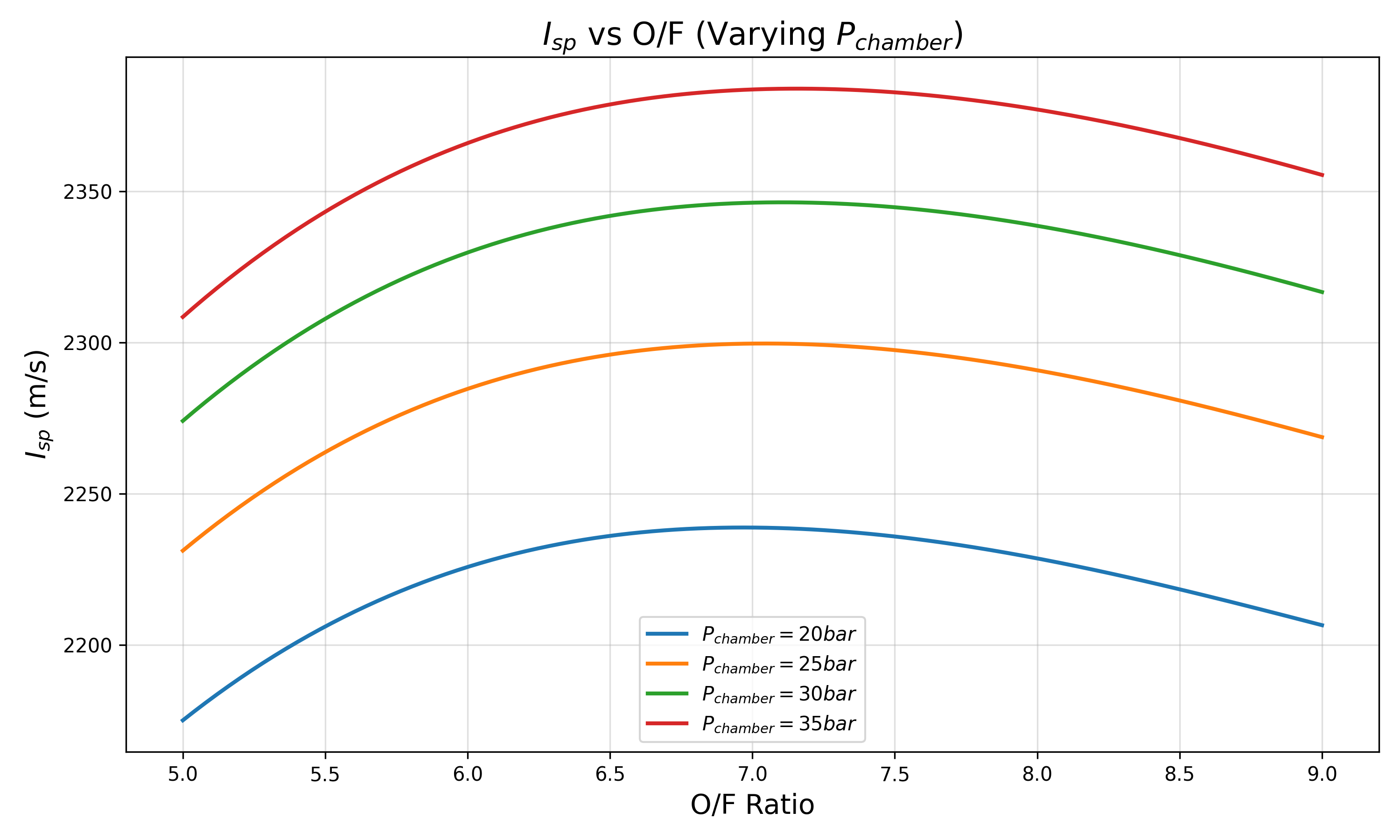
Another key performance parameter for the engine is the characteristic velocity c*, which is independent of the nozzle performance. The results of different c* over O/F ratio is shown here: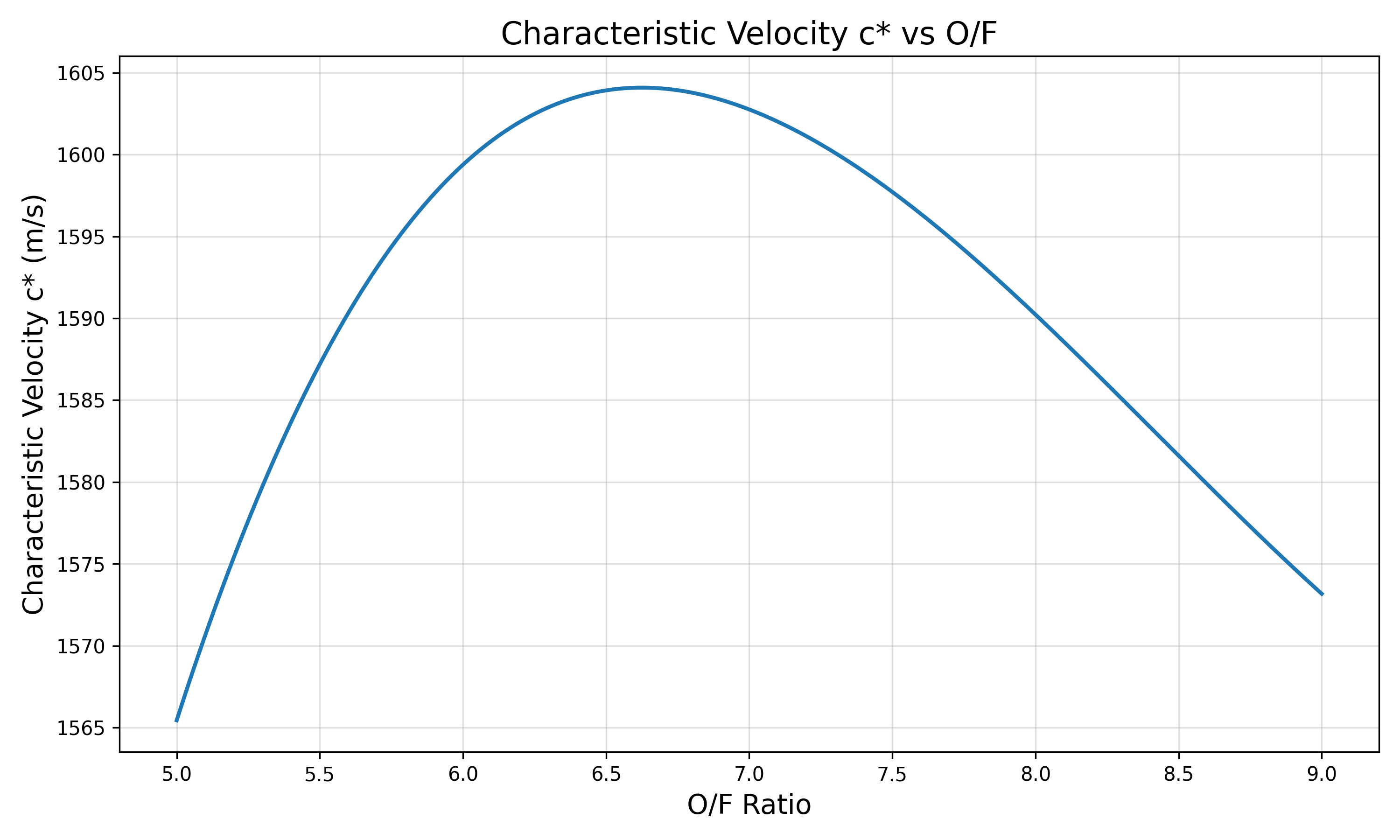
On the basis of these two performance metrics, a decision of the desired chamber pressure and O/F ratio was made. In order to reduce the combustion chamber temperature and stresses, a combustion chamber pressure of =30 bar was chosen. Furthermore the O/F ratio was set to O/F=6 in accordance with other team designs. Another important reason is to limit oxidation of the nozzle and also to reduce the temperature from stoichiometric conditions.
¶ Propellant Weight Calculation
In this section the weights of the propellants are calculated. The specific Impulse for the design combustion chamber pressure of and is . On the basis of other team reports, an acceleration during lift-off of 5g should be achieved for a stable launch. With an expected launch mass of the rocket of 20kg, the thrust requirement is the following:
This is rounded to 1kN. On the basis of these values and an expected efficiency of 90%, the total propellant mass flow can be calculated to:
.
From this total massflow, the oxidizer and fuel massflow can be determined through the O/F ratio. The fuel massflow is:
The oxidizer massflow is therefore:
With an assumed burn time of we get the propellant weights of: